

This is not an Immigration Debate.
This is an Economic Reality.
The Idaho Alliance for a Legal Workforce commissioned an independent economic analysis to answer a straightforward question: what does foreign-born labor actually contribute to Idaho’s economy, and what happens if half of it disappears?
The findings are clear. Foreign-born workers in agriculture, construction, and hospitality are not filling optional roles. They support an economy that every Idaho family depends on. These industries account for 35.5% of all jobs in Idaho and 31.4% of the state’s gross regional product.
The estimates are conservative, and the conclusions are validated by Idaho’s own industry leaders.
The Recession Comparison
The Great Recession was Idaho’s worst post-WWII downturn. Housing employment fell 41%, and recovery took nearly a decade.
This study projects a 4–5% decline in gross state product, comparable in scope. The difference? This would be self-inflicted: a broken federal system with no plan to replace the workforce it removes.
$5.1 B
55,818
Total statewide
job losses
397.8 M
Lost state & local tax
revenues
$12.3 B
Reduction in transactions
What Workforce Disruption Means for Idaho's Bottom Line
Select any sector below to see the projected economic impact, sourced directly from the study.
Agriculture & Dairy
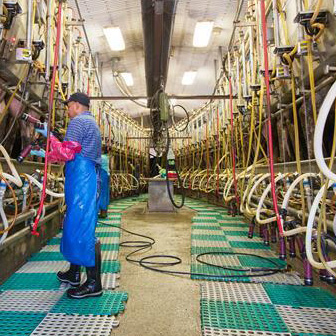
Dairy runs on foreign-born labor.
Dairy alone generates $8.4 billion in economic activity and supports 25,000+ jobs. According to the Idaho Dairymen’s Association, nearly 90% of dairy farm labor is foreign-born. And yet, no year-round visa exists for this industry.
The study modeled the impact of removing roughly half of the unauthorized dairy workforce:
$3.8 B
Lost transactions
$1.24 B
Drop in Gross State Product
11,353
Jobs lost statewide
Local dairy processors (cheese plants, yogurt facilities, ingredient operations) cannot easily source milk from other states. If dairy production contracts, processing contracts with it. Processing jobs average $84,801/year and don’t come back quickly.
All agricultural sectors combined: $3 billion in GSP losses and 27,729 jobs eliminated.
FOUNDATION OF THE ECONOMY
Agriculture and dairy are base industries.
They bring money into Idaho.
Non-dairy agriculture alone accounts for 90,000 jobs and $9.6B in GRP including multipliers. The dairy cluster adds $4.4B. These are export-oriented industries. When they contract, the retail shops, medical offices, and service businesses they support contract with them. (Peterson & Nadrequ, Ch. 4)
Construction & Housing
Idaho’s housing crisis gets worse without these workers.
Idaho has the fastest-growing housing prices in the nation, up 168% since 2014. It also had the fastest cumulative population growth (22%). The median home now costs: $462,014, making Idaho the 7th least affordable state, where 67% of households are priced out of purchasing a home.
Construction employment nearly doubled (95% increase) during the same time frame. The exposure is in residential construction: framing, drywall, roofing, and concrete.
A 13% contraction would produce:
$2.9 B
Lost statewide transactions
$1.44 B
Lost Gross State Product
16,186
Jobs eliminated
There is no out-of-state substitute for local residential construction labor. Families pay higher rents, delay homeownership, or leave Idaho.
HOUSING AFFORDABILITY CRISIS
Idaho’s unaffordability index:
6.2 years of full income to buy a median home.
Idaho went from low-cost to high-cost in a single decade. The Great Recession cut housing employment 41% and took years to rebuild. A second workforce disruption repeats that cycle while 67% of households are already priced out. (Peterson & Nadreau; Zillow)
Hospitality & Dining
Tourism depends on this workforce.
With 12.9 million overnight visitors in 2023 and $5.83 billion in spending, accommodation and food service employment grew 40% from 2014 to 2024, reaching 80,000+ jobs.
Modeled scenario: removing half of the estimated 20% undocumented share:
$1.4 B
Reduced transactions
$743M
Lost Gross State Product
11,902
Jobs eliminated
A hotel room cannot be staffed from Nevada. A restaurant kitchen in Coeur d’Alene cannot import line cooks from Utah. When these workers disappear, Idaho’s $5.8 billion tourism industry shrinks.
The Supply Chain Effect
When one worker leaves, more than one job disappears.
Of the 55,818 total jobs projected to be lost, 28,725 are direct foreign-born losses. The remaining 27,093 are American-born Idaho workers who would lose jobs in downstream industries: trucking, feed supply, veterinary services, hardware, and accounting.
The Fiscal Cost:
$397.8 Million in Lost State Tax Revenue
When businesses contract, the state’s tax base contracts with them. If Idaho were to lose nearly $400 million in state tax revenue, that would compound the current budget problems and essentially double the $500 million plus deficit that was projected in November of 2025.

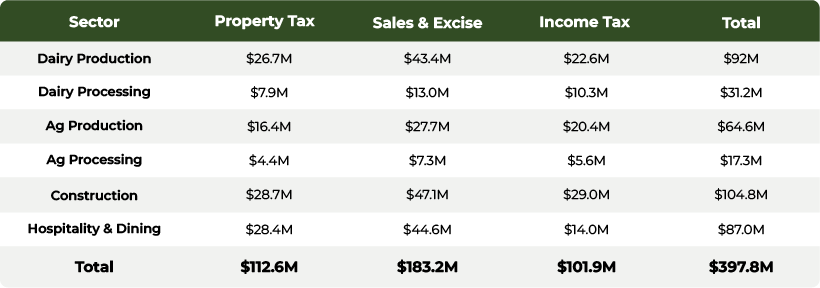
$397.8 million equals Idaho’s entire public safety budget: state troopers, prisons, and courthouses combined. The federal government would also lose $701.6 million in tax receipts from Idaho alone.
Read the Full Study
The complete economic analysis, including methodology, sector-by-sector data, and fiscal projections, is available for download. It was prepared by regional economists Steven Peterson, MS and Timothy Nadreau, PhD, and is fully cited with data from the BLS, BEA, U.S. Census, IMPLAN, and Lightcast.

Ready to Take Control of your Finances?
Mon-Fri:
8:30am-5:30pm