

Understanding the Problem
No Access to Year-Round Workers
Most Idahoans assume that if an employer needs a worker, there’s an existing work visa. For agriculture, construction, and hospitality, there is no year-round solution to help address the workforce gap they face.
KNOWLEDGE GAP
Half of Idaho voters think these pathways exist. They don’t.
In a January 2026 survey of 716 Republican voters, nearly half believed year-round agricultural visa programs already exist. This is a critical knowledge gap in the immigration debate.
When voters believe pathways exist, they see no need for reform. The current visa framework was built in the 1980s for seasonal crop harvests, not for year-round dairy, continuous construction, or 365-day hospitality operations.
This is a description of a federal system that has not kept pace with economic reality, not a criticism of workers or a defense of illegal immigration.
HOW THE VISA SYSTEM ACTUALLY WORKS
What Exists, and What’s Missing
H-2A: The Only Agricultural Visa.
And it's Seasonal.
The H-2A visa is the primary, and essentially only, pathway for foreign-born agricultural workers to enter the United States.
Here's what it does:
- Requires employers to prove no domestic workers are available. For example in 2025, farmers advertised 7,626 jobs and only 5 Americans applied
- Allows employers to bring foreign workers for temporary or seasonal agricultural labor
- Requires workers to return home after the season ends
- Requires employers to pay a federally set “adverse effect wage rate,” which in Idaho for 2025 was $16.83/hour
- Requires employers to provide OSHA certified, safe housing and transportation to and from the country of origin.
- Requires the employer to hire a domestic worker before any foreign-born worker and provides all the same pay and benefits
- Applications need to be submitted 60–75 days prior to an employee’s start date and require significant administrative cost
What it does not cover: year-round employment, dairy, food packing, construction, hospitality and food service, food processing, or any path to residency.
The H-2A covers seasonal crop work. Idaho’s dairy farms, which are among the largest employers of foreign-born labor in the state, are explicitly excluded. Cows don’t stop producing milk in October.
→ Verify this at USCIS.gov: H-2A Temporary Agricultural Workers
H-2B: Non-Agricultural Seasonal Work.
Capped and Seasonal.
The H-2B visa covers temporary non-agricultural workers, such as seasonal resort staff, landscapers, and similar roles.
Key limitations:
- Congressionally capped at 66,000 visas per year for the entire United States
- Seasonal and temporary only, not year-round
- Historically oversubscribed; employers often can’t get visas even when they qualify
- Does not cover agriculture or any permanent, year-round positions
- Hospitality, construction, forestry, food services, and manufacturing employers all compete for this limited pool
- The capped 66,000 visas consistently fall short of the high demand from U.S. employers for seasonal work
For Idaho’s hospitality sector already running at near-full employment with 84 workers for every 100 job openings across all industries, the H-2B provides marginal relief at best. It was not designed for a state experiencing 40% growth in accommodation and food service employment.
→ Verify this at USCIS.gov: H-2B Temporary Non-Agricultural Workers
H-1B and Other Skilled Visas:
Not for This Work.
There is simply no visa category in the U.S. federal system designed for a year-round, essential-industry, manual-labor worker.
The H-1B visa is designed for specialty occupations requiring at least a bachelor’s degree: technology, engineering, medicine, finance. It is not a pathway for agricultural workers, construction laborers, dairy farmhands, or restaurant employees. Neither are the O, L, or TN visa categories, which cover extraordinary ability workers, intracompany transferees, and certain Canadian/Mexican professionals respectively.
What Idaho Needs Vs. What Exists
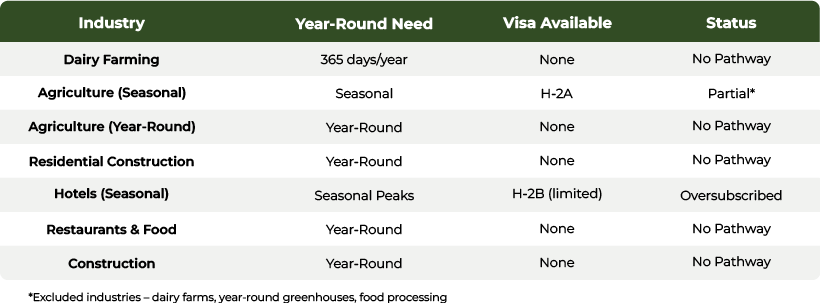
*Excluded industries – dairy farms, feedlots, year-round greenhouses, food processing
What "Fix the System" Means
State enforcement-only approaches, like mandatory E-Verify, without new visa pathways, simply remove workers without replacing them, compounding the economic damage.
The goal is to fix the system that created the status quo. Create legal pathways. Enforce against those who don’t use them. That’s how rule of law works.
Congress should create a year-round, legal visa pathway for essential-industry workers: an expanded H-2A covering dairies, a new category for construction and food service, and a framework that lets workers and employers operate within the law.
Verify at USCIS.gov
All visa information can be verified at: uscis.gov/working-in-the-united-states/temporary-nonimmigrant-workers

Ready to Take Control of your Finances?
Mon-Fri:
8:30am-5:30pm